
Trained 4-bit versus rounded 4-bit on a Mac
We brought an NVIDIA ModelOpt checkpoint to MLX and compared it with a community 4-bit pack. Better tool calling, Swedish grammar and translation gave us a practical reason to try trained low-bit models on a Mac.

Chapters
Choosing a low-bit model is often presented as a choice of size. Find a pack that fits in memory, check whether it runs quickly enough, and start asking questions. But equally compact downloads can contain different compromises.
One route rounds a model's weights after training: post-training quantization, or PTQ. Another trains with the quantized representation in mind. We compared a checkpoint that NVIDIA describes as produced with quantization-aware distillation, or QAD, with a community PTQ pack on the same Mac.
The first result seemed to make the choice easy. The trained pack had much lower perplexity on English text. Then we asked the models to write code, solve maths problems, call tools and work with Swedish.
The trained pack was better on tool calling, Swedish grammar and translation. Code and maths were not distinguished at the tested sample sizes. The interesting question became where the advantage appeared, rather than whether one number could declare a winner.
What ModelOpt brings to the comparison
NVIDIA Model Optimizer, or ModelOpt, is an open-source toolkit for preparing models for more efficient inference. It supports post-training quantization as well as techniques that involve further training. ModelOpt prepares the checkpoint; an inference runtime then uses it to answer requests.
The distinction that matters here is quantization-aware distillation. A quantized student learns from a higher-precision teacher, with quantization included during training. Instead of only rounding an existing model into fewer bits, this gives the student a chance to adapt to that smaller representation. It does not guarantee a better result on every task, which is why we tested the resulting checkpoint.
NVIDIA did that optimization work for the checkpoint we used. Our part was to bring it into MLX and evaluate it on Apple silicon. That requires the receiving runtime to understand the packed weights, their scales and the model architecture. We converted this checkpoint for oMLX, a server built on MLX, without another round of weight quantization.
The useful possibility is to run a model already adapted to low precision on a Mac, without repeating its distillation. This article tests one such conversion and asks what the trained pack actually improves over a familiar community alternative.
The two packs we actually compared
The source was NVIDIA's Qwen3.8-Flash-Next-FP4-Local checkpoint, a package of about 95 GiB. We converted it for MLX without requantizing its weights. Its routed experts use the trained NVFP4 representation; attention and shared experts use MXFP8, with a protected set of higher-precision parameters.
The comparison was the mlx-community Qwen3.8-Flash-Next 4-bit pack. It uses 4-bit affine quantization with group size 32, while 96 modules use 8-bit quantization with group size 64.
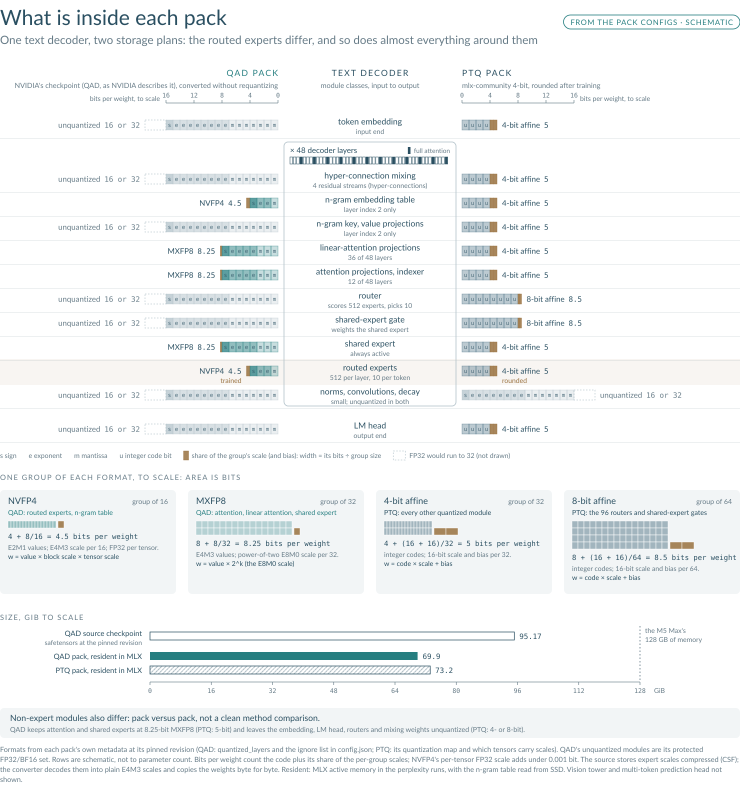
The packs' precision layouts show both the trained-versus-rounded expert weights and the higher-precision modules that prevent a clean method-only comparison. Formats come from each pack's own configuration at its pinned revision; bits per weight follow from the format definitions, and the rows are schematic, not to parameter count.
Both ran through the same oMLX runtime on an M5 Max with 128 GB and MLX 0.32.4. Their resident sizes were similar, at 69.9 GiB for the QAD pack and 73.2 GiB for PTQ. Task comparisons used greedy, non-thinking generation with speculative decoding disabled, the same items and identical prompt token IDs per item.
The trained pack is published as precisit/Qwen3.8-Flash-Next-QAD-NVFP4-MLX, about 98 GiB on disk. The resident sizes above are smaller because oMLX read the model's n-gram table from SSD in these runs. The model card explains which oMLX setup and memory setting it needs.
This is pack against pack, not an isolated experiment proving QAD better than PTQ as a method. Their non-expert modules also differ, so an advantage cannot be attributed to QAD alone.
Perplexity made a promise the tasks did not repeat
Perplexity measures how well a model predicts the next tokens in a text. Lower is better. It is useful because it asks a consistent question over many positions, without needing a separate grading rule for each task.
On paired, chat-framed English text, the QAD-to-PTQ perplexity ratio was 0.730, with bounds of 0.700–0.759. QAD was lower on all 121 documents. On Swedish, the ratio was 0.914, with bounds of 0.910–0.918, and QAD was lower on 127 of 128 documents.
This was not a held-out English evaluation: 80 of the 121 documents came from WikiText’s training split. The 41 test-split documents alone gave a QAD-to-PTQ perplexity ratio of 0.744. The English perplexity gap was larger, but the task results did not follow that ordering.
| Task | Trained pack | PTQ pack | What the panel established |
|---|---|---|---|
| HumanEval+ code, 164 items | 94.51% | 95.73% | Not distinguished |
| GSM8K maths, 250 items | 96.80% | 96.00% | Not distinguished |
| BFCL tool calls, 401 items | 79.30% | 69.33% | QAD ahead |
| ScaLA Swedish grammar, 2 048 items | 79.64% | 76.22% | QAD ahead |
| Belebele Swedish reading, 900 items | Above 92% | Above 92% | Not distinguished |
| FLORES+ translation, chrF++ | 65.60 | 64.66 | QAD ahead |
Translation uses a reference-based character-overlap score, not a percentage of tasks passed. Its scale should not be compared directly with the accuracy rows.
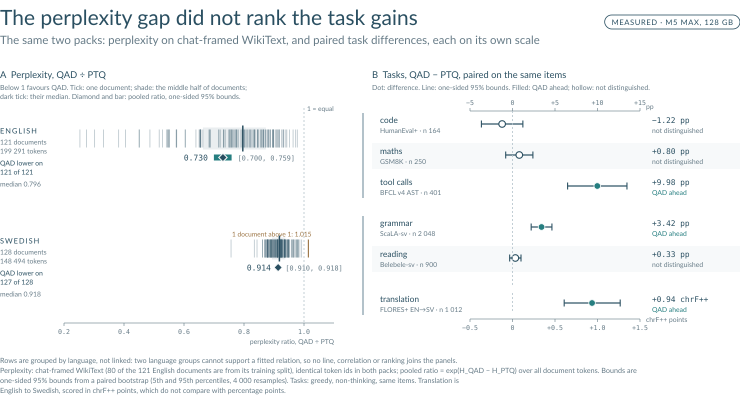
Separate perplexity and task-result panels show that the larger English perplexity gap did not imply a larger code or maths advantage. Measured on an M5 Max with 128 GB: each tick is one document, bounds are one-sided 95% bounds, and the two panels share no scale.
For code and maths, “not distinguished” does not mean equal. The minimum detectable effects were 2.48 and 1.60 percentage points, respectively. A smaller difference could remain unresolved in this panel.
Swedish reading was also unresolved: the paired gain was +0.33 points, against a minimum detectable effect of 0.69. The other Swedish tasks gave a different answer.
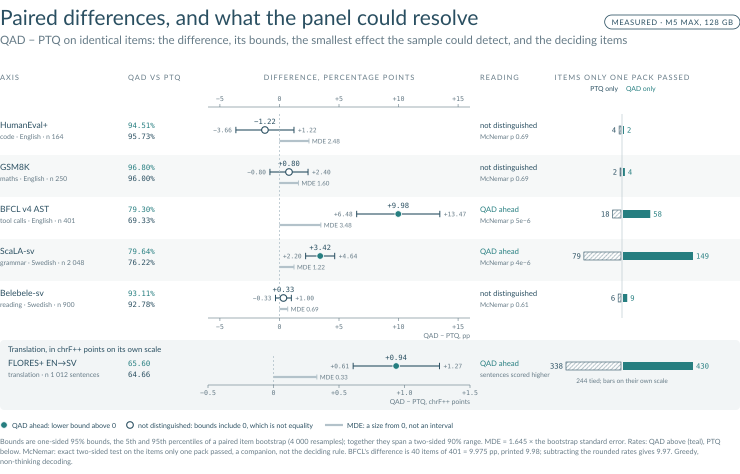
Paired task differences and their bounds distinguish measured advantages from unresolved comparisons, with translation kept on its own scale. The minimum detectable effect is drawn as a size from zero, not as an interval, and the bars on the right count the items only one pack passed.
A better tool score partly meant deciding to call
The trained pack led by 9.98 percentage points on BFCL's AST tool-calling checks, with one-sided bounds of +6.48 to +13.47 points. These checks grade the structure and arguments of tool calls; they are not a measurement of a complete agent carrying out a long job.
Looking inside the result made it more useful. Among the 332 items that needed a tool call, PTQ made no call on 32. QAD made no call on 8. About half of the gain on items that needed a call came from this willingness to call at all: 23 of the 44 additional passes.
There was also a difference when both packs called. On those 294 items, QAD passed 83.3%, compared with PTQ's 76.2%.
More willingness is not always better. On the 69 irrelevance items, where correctly declining to call was the task, PTQ passed 50 and QAD passed 46. Across the whole panel, the 40 extra passes therefore combined 23 from call propensity and 21 from accuracy when both called, offset by 4 fewer passes on irrelevance.
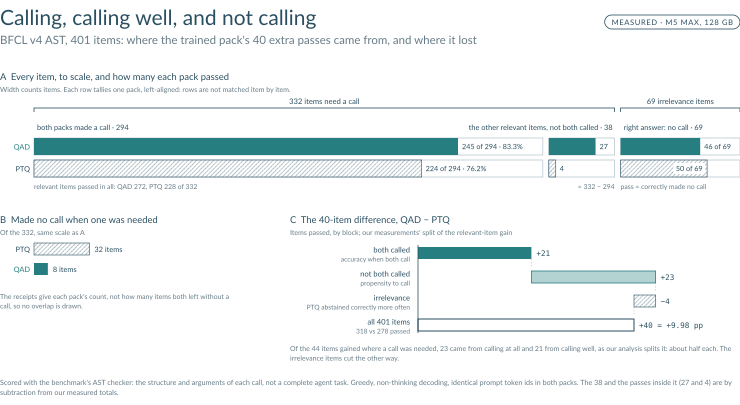
Missing calls, accuracy when both packs call, and correctly withheld calls explain why tool-call propensity helps some requests and harms others. Widths count BFCL items; the two packs' no-call counts are shown separately because their overlap was not reported.
An application developer can use that distinction. If missed calls are expensive, the first difference matters. If unnecessary calls are risky, the counter-case matters too. A single leaderboard score contains both behaviours.
Swedish improved in a specific way
On ScaLA-sv, which asks whether a sentence is grammatical, QAD led by 3.42 percentage points, with bounds of +2.20 to +4.64.
An exploratory split showed where that gain came from. QAD identified corrupted sentences more accurately, at 73.5% versus 63.4%. PTQ was better at accepting correct sentences, at 89.1% versus QAD's 85.7%. The overall grammar gain therefore did not mean an improvement on both kinds of decision.
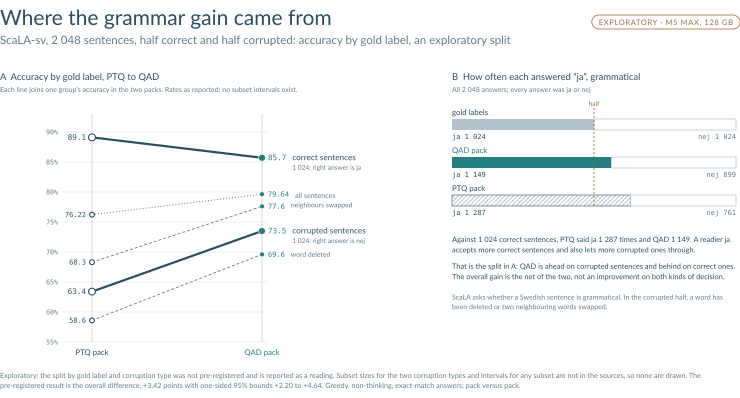
Separate correct and corrupted sentence groups show the exploratory source of the grammar gain and the opposite ordering on valid sentences. The split was not pre-registered and has no subset intervals; the right panel shows how often each pack judged a sentence grammatical.
For English-to-Swedish translation, QAD scored 65.60 against 64.66 on chrF++, a paired difference of +0.94 with bounds of +0.61 to +1.27. That supports a translation advantage in this test. It is not a general assessment of literary style or every kind of Swedish writing.
The comparison is instructive: a smaller perplexity gap on Swedish coexisted with detectable grammar and translation gains, while the larger English gap did not separate code or maths. Perplexity remains useful. In this pair, it did not tell us which tasks would benefit.
What happened when activations became int8?
Weights are only part of the calculation. Activations, the intermediate values passed through the model, have their own precision.
Within the QAD pack, we also tested int8 activations with NVFP4 weights against the bf16-activation route. The int8 arm was not distinguished on any of the six task axes and met the prespecified non-inferiority margins on all of them. On HumanEval+, it passed and failed the same 164 items.
That is evidence of no measurable quality cost within this panel and those margins, not proof of identical behaviour on every request. It is also separate from speed: the scored int8 route was slower, while a later kernel path produced faster timing readings. Those runs do not support treating a precision label as a performance guarantee.
Conversion without another round of rounding
Our converter carried weights and block scales byte for byte, apart from an integer decode of the compressed scale planes. All 2 452 reread tensors in the mlx-lm pack, and every tensor in the oMLX pack, matched their expected source values. It did not dequantize and requantize the trained checkpoint. The oMLX target preserved the source global scales exactly. In the separate mlx-lm target, its scale parameterization left 8 686 of 73 728 routed-expert global scales one fp32 unit in the last place low. That representational limit does not describe the oMLX route used for the task comparison.
We also recorded a failed cache-consistency criterion. Later analysis classified the observed oMLX differences as computation-path rounding; it did not turn the original failed criterion into a pass. Full-model agreement between the separate mlx-lm target and oMLX remains outside this article's claims.
Our unpublished protocol records the original tests and dated amendments for later arms.
Conclusion: bringing trained low-bit models to the Mac
We brought an NVIDIA ModelOpt checkpoint into MLX without requantizing its weights, then compared it with a community PTQ pack in the same oMLX runtime. The trained pack improved measured tool calling, Swedish grammar and translation at a similar resident size. Code, maths and Swedish reading remained unresolved at the tested sample sizes. Its lower perplexity was a reason to investigate, rather than a substitute for those task results.
The value is another usable choice for local AI: a checkpoint that carries NVIDIA's low-precision training work into an MLX deployment. The two packs differ in more than their training method, so this comparison cannot tell us how much of the advantage came from distillation alone. It does show useful task advantages for this trained pack in our Mac setup.
To try it, start with the released pack and its oMLX setup instructions. We ran it on a Mac with 128 GB of memory. Check the model card's memory requirements and settings before downloading, then compare it with the pack already serving your own requests. Include a tool that should be called and one that should not, or a few sentences in a language you work with. Keep the prompts and runtime settings the same, and look at the answers as well as the memory use.
A model's useful life need not end at the hardware it was optimized for. Here, the work of adapting it to fewer bits became something we could run and test locally. What would a trained low-bit model change in the work you ask your Mac to do?